Education
- Master of Design
- White Papers
- Undergraduate
- Graduate
- Design@Large
- Online / Extension
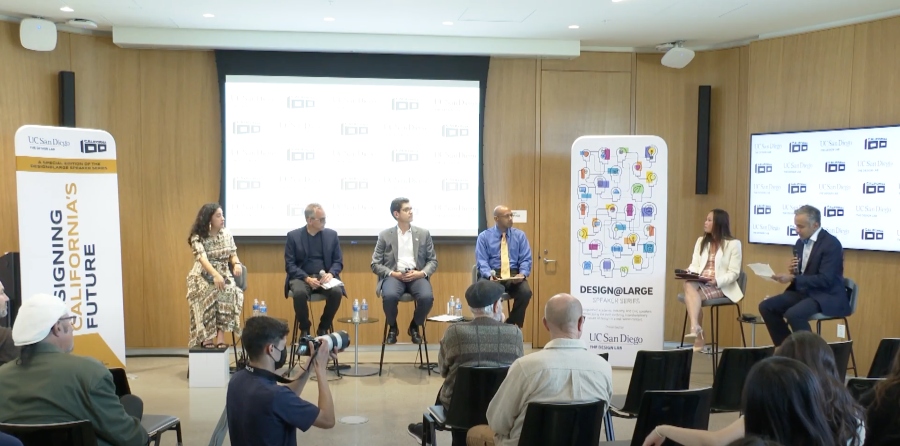
The Design@Large speaker series highlights a different central theme within design during each fall, winter, and spring quarter to inspire attendees and showcase the brightest minds tackling issues impacting humanity. Design@Large is a course at UC San Diego and is also open to the public as a way of sharing cutting-edge research and innovative insights with a wider audience. Undergraduate students can sign up for DSGN 119 and graduate students can enroll in DSGN 219 (cross-listed with COGS 229 and CSE 219).
Design@Large was pioneered as a collaborative effort with UC San Diego faculty who shared the collective vision of drawing together a community of individuals from various design disciplines. A new wave of societal challenges, cultural values, and technological advancements is creating exciting opportunities for designers everywhere to make a global impact, and Design@Large provides the chance to learn about these opportunities as they emerge.
This fall, we're asking: what will the university be in 20 years?
AI is reshaping the economy faster than institutions can adapt. Career paths are unrecognizable. Credentials that were supposed to be portable lose meaning overnight. And yet institutions move slowly.
This speaker series brings together people working on that gap. Researchers and practitioners designing new models of education, rethinking what credentials actually signal, and asking hard questions about what institutions need to become. Some work inside universities trying to change them. Others build alternatives from outside. Across five sessions, we will share time with thought leaders examining institutional futures with hiring practitioners working in industry right now.
How to Start by Jodi Kantor is the core reading for the course. Drawing on years of reporting on work and ambition, Kantor offers a practical framework for figuring out what to do next when the old rules for careers no longer apply. Purchase the book here.
WHEN: Wednesdays, 4:00 - 5:00 PM: Sept 30, Oct 14, Oct 21, Oct 28, Nov 18
WHERE: DIB 208
FORMAT: In-person · Open to the Public · Livestreamed
COURSES: DSGN 119/219 · CSE 219 · COGS 229
QUARTER: Fall 2026 · September – December
Join us for an introductory session from Professor Scott Klemmer, the faculty on record for this Design@Large!
About Our Speaker: Prof Scott Klemmer is a Professor of Cognitive Science and Computer Science & Engineering at UC San Diego, where he co-founded the Design Lab. He previously served as Associate Professor of Computer Science at Stanford, where he co-directed the HCI Group, held the Bredt Faculty Scholar chair, and was a founding participant in the d.school. He has a PhD in CS from Berkeley and a dual BA in Art-Semiotics and Computer Science from Brown (with Graphic Design work at RISD).
Will AI revolutionize schooling, as many industry experts expect? In this talk, I argue for a more modest, measured, and historically informed approach to these questions. Drawing on earlier attempts to radically transform schooling with the new media technologies of the moment, I trace the cyclical processes by which waves of techno-optimism recur in education reform, leading to ambitious and often well-intentioned interventions that routinely end in failure. By better understanding how and why this cycle persists despite its predictable failings, technology designers and education reformers can better serve students, teachers, and parents with the pragmatics of their daily lives.
About Our Speaker: Christo Sims is an Associate Professor of Communication at UCSD, with affiliations in Urban Studies, Science Studies, Ethnic Studies, and the Design Lab. He is the author of Disruptive Fixation: School Reform and the Pitfalls of Techno-Idealism (Princeton), which won the Best Book Award from the Communication, Information Technology, and Media Sociology section of the American Sociological Association. During the 2020-21 academic year, he was an in-residence member of the School of Social Science at the Institute for Advanced Study in Princeton.
This talk will start with a pragmatic question: What are the implications of recent advances in code generation and other AI capabilities for the design of future interactive systems? My group has been investigating this question in a number of different application areas, from games that modify their behavior at runtime to tools that help physical therapists prescribe mixed-reality exercises and programming environments for end users and experts. In each case, code generation enables new interactions, but also has important limitations.
We will then shift to an epistemic question: What are the impacts of AI advances on the ways we generate new knowledge through our research? What should an impactful HCI systems research project look like as building working systems becomes substantially easier? I argue that we should ask more of our projects and papers as implementation becomes less of a bottleneck: we can be more rigorous in our exploration of design spaces and in our evaluations, and we may need to develop new research methods along the way.
About Our Speaker: Björn Hartmann is an Associate Professor in EECS at UC Berkeley where he holds the Paul and Judy Gray Alumni Presidential Chair in Engineering Excellence. He is broadly interested in tools to support human ingenuity, across a number of domains including design, programming and engineering. He is a member of the CHI Academy and his research has received numerous Best Paper Awards at top Human-Computer Interaction conferences. He completed his PhD in Computer Science at Stanford University in 2009, and received degrees in Digital Media Design, Communication, and Computer and Information Science from the University of Pennsylvania in 2002.
About this Talk:
Jodi Kantor's How to Start is essential reading for this moment, and the required reading for the course. She asks the question institutions are ducking: what matters when credentials stop signaling what they're supposed to? Her answer is craft. Real work. What you can demonstrate. It cuts through the noise of a labor market moving faster than degrees can track.
This session flips the typical speaker format. Jodi will be onstage in conversation with UCSD students. Not as audience members, but as interlocutors asking her directly about the work they're doing, the portfolios they're building, the futures they're imagining. Students already know they can't wait for institutions to figure this out.
About Our Speaker:
Jodi Kantor is a Pulitzer Prize-winning investigative reporter for The New York Times and a bestselling author whose groundbreaking work has helped shape conversations around power, gender, law, and culture.
In 2017, Kantor and Megan Twohey broke the story of decades of sexual abuse allegations against Harvey Weinstein, helping spark the global #MeToo movement. Their reporting earned the Pulitzer Prize for Public Service and inspired the bestselling book She Said, later adapted into a feature film.
Kantor’s investigations have also prompted changes at major companies, including Amazon and Starbucks, and inspired innovations that support breastfeeding mothers. More recently, her reporting has shed light on the inner workings and ethics of the U.S. Supreme Court.
Her bestselling books include The Obamas, She Said, and How to Start: Discovering Your Life’s Work. Recognized as one of Time magazine’s 100 most influential people, Kantor is known for revealing hidden truths and demonstrating how investigative journalism can drive meaningful change.
A lecture series, an open community event, and a video series viewable on YouTube.
Watch all recorded D@L series here: