Design@Large

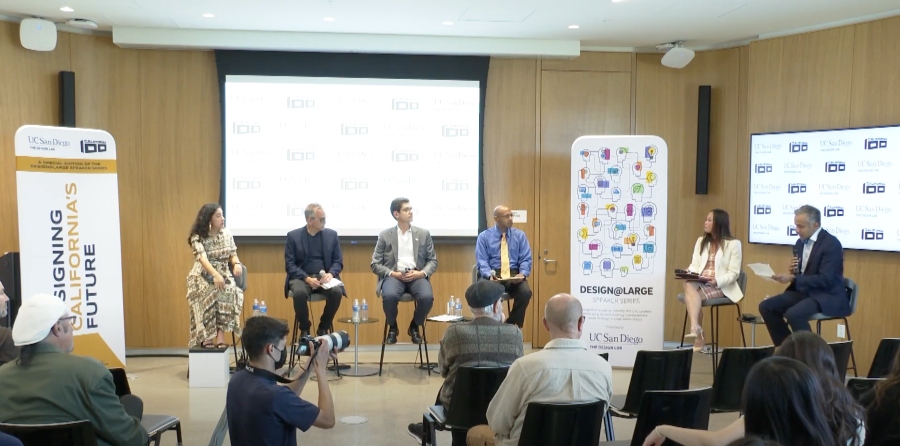
Seated audience watching Design at Large speaker series

The Design@Large speaker series highlights a different central theme within design during each fall, winter, and spring quarter to inspire attendees and showcase the brightest minds tackling issues impacting humanity. Design@Large is a course at UC San Diego and is also open to the public as a way of sharing cutting-edge research and innovative insights with a wider audience. Undergraduate students can sign up for DSGN 119 and graduate students can enroll in DSGN 219 (cross-listed with COGS 229 and CSE 219).

Design@Large was pioneered as a collaborative effort with UC San Diego faculty who shared the collective vision of drawing together a community of individuals from various design disciplines. A new wave of societal challenges, cultural values, and technological advancements is creating exciting opportunities for designers everywhere to make a global impact, and Design@Large provides the chance to learn about these opportunities as they emerge.

Design at Large Spring 2026 event banner. Designing AI: Shaping Human-Centered Futures. Wednesdays, 4-5 PM, Design & Innovation Building Room 208. UC San Diego The Design Lab.

Spring 2026: Designing AI: Shaping Human-Centered Futures

Artificial intelligence is no longer confined to research labs or technical infrastructure—it is embedded in classrooms, creative practice, healthcare systems, communication platforms, and planetary-scale infrastructures. As AI systems move from experimental tools to everyday companions, decision-makers, and mediators of social life, the question is no longer whether AI will shape our future, but how—and by whom.

At the Design Lab, we approach AI not simply as an algorithmic achievement, but as a fundamentally human-centered design challenge. Intelligent systems must be technically robust, yet responsive to lived experience; powerful at scale, yet grounded in context; innovative, yet attentive to equity and responsibility. Across seven sessions, Design@Large Spring 2026 brings together leading voices from research, industry, education, law, health, and the arts to explore how AI is designed, deployed, governed, and experienced in real-world settings.

From generative AI in education and music to embodied intelligence in XR, from disability justice and communication to sustainable computing and Indigenous data sovereignty, and from personal AI companions to value-based care in health systems, the series examines AI where it meets people, institutions, and infrastructures.

Rather than treating AI as a purely technical system, we frame it as a site of negotiation among human values, institutional incentives, cultural norms, and material conditions. Each session pairs scholars, practitioners, and industry leaders to interrogate how design decisions shape agency, creativity, trust, access, and care at scale. Design@Large is open to the broader public and livestreamed online, while also serving as a core seminar for over 100 undergraduate and graduate students at UC San Diego.

WHEN: 4:00 - 5:00 PM

WHERE: DIB 208

FORMAT: Open to the Public · Livestreamed

COURSES: DSGN 119/219 · CSE 219 · COGS 229

QUARTER: Spring 2026 · April – June

Series info & livestream


April 1 · Series Introduction (Students Only)

Speaker: Nadir Weibel · UC San Diego

This opening session introduces the Design@Large series and frames AI as something actively designed into social, cultural, and institutional worlds—not just built as a technical system. Alongside this conceptual framing, the session also covers course logistics, expectations, formats, and opportunities for student participation, helping situate the series as both an intellectual journey and a shared learning experience for the quarter.


April 8 · Learning in the Age of GenAI: Practice, Policy, and Pedagogy

Speakers:
  • Stephen MacNeil · Temple University
  • Leo Porter · UC San Diego
  • Sydney Sullivan · SDSU
  • Rafael Eaton · La Jolla Country Day School

Generative AI is reshaping how knowledge is produced, taught, assessed, and governed across educational contexts—from K–12 classrooms to university computer science labs. This session examines how AI tools are being integrated into pedagogy, how misuse and cognitive offloading are understood and managed, and how institutions are defining new norms and policies around learning. Rather than asking whether AI belongs in education, the discussion focuses on how educators, researchers, and school leaders are actively shaping its role in practice.


April 15 · Personal AI Companions: Designing Agency, Intimacy, and Social Interaction 

Speakers:

  • Gale Lucas · USC
  • Suman Kanuganti · Personal AI
  • Raj Ammanabrolu · UC San Diego / NVIDIA
  • Edy Goulet · Metalab

As AI systems increasingly act as companions, collaborators, and conversational partners, they occupy emotionally and socially meaningful roles. This session brings together affective computing, computational models of social reasoning, deployed personal AI systems, and interface design to examine how social presence is engineered in AI. The discussion explores how social reasoning is modeled in agents to anticipate and respond to human behavior, how agency is negotiated between humans and machines, and how intimacy is designed into interactions that feel socially intelligent.


April 22 · Embodied AI at Scale: XR, Platforms, and Spatial Intelligence 

Speakers:

  • Ignacio Contreras · Qualcomm
  • Ziad Asghar · Qualcomm
  • Neil Smith · UC San Diego

Embodied AI moves intelligence into physical and perceptual space through XR, wearables, and spatial computing platforms. This session examines how embodied systems are not only built but productized and scaled—connecting hardware platforms, interface design, and human factors. Bringing together industry and research perspectives, the discussion explores how spatial AI systems shape perception, movement, and interaction, and how design decisions determine whether embodied intelligence feels intuitive, trustworthy, or intrusive.


April 29 · Creative AI: Music, Authorship, and Algorithmic Culture

Speakers:

  • Nicholas Bryan · Adobe
  • Orly Lobel · University of San Diego School of Law
  • Shahrokh Yadegari · UC San Diego

Creative AI is transforming how music and other cultural works are composed, produced, and circulated, reshaping relationships between artists, platforms, and audiences. This session brings together artistic practice, industry development, and legal scholarship to explore how generative tools influence creative agency, authorship, and ownership. The discussion considers how AI systems collaborate with creators, how intellectual property frameworks are adapting, and how cultural value is negotiated in algorithmic environments.


May 13 · Unequal Voices: Disability, Communication, and Justice in AI 

Speakers:

  • Anne Marie Piper · UC Irvine
  • Alexander Dunn · Cephable
  • Carol Padden · UC San Diego

AI systems mediate communication at massive scale—but not all voices are heard, represented, or valued equally. Centering disability as expertise, this session explores how communication technologies embed normative assumptions about language, cognition, and ability. Bringing together accessible computing, assistive technology practice, and critical disability scholarship, the discussion moves beyond usability to justice—asking how AI can expand participation without reproducing structural inequities.


May 20 · Who Owns AI? Data, Land, and Planetary Futures

Speakers:

  • Josiah Hester · Georgia Tech
  • Bharathan Balaji · Amazon
  • Keolu Fox · UC San Diego

AI systems rely on vast material infrastructures—data, energy, land, and labor—that are unevenly distributed and often obscured from view. This session examines ownership and sovereignty in AI from technical, environmental, and Indigenous perspectives. By connecting sustainable computing, climate-scale machine learning, and data sovereignty, the discussion asks who benefits from AI systems, who bears their costs, and how planetary futures are shaped through design and governance decisions.


May 27 · Health, Mental Health, and the Architecture of Value-Based Care in AI

Speakers:

  • Munmun De Choudhury · Georgia Tech
  • Peter Westlake · MindNumbers
  • Jake Sunshine · Univ. of Washington / Google
  • Kavya Reddy · hermony.life

AI is increasingly embedded in clinical and mental health systems, shaping how care is delivered, measured, and scaled. This session examines how AI participates in the architecture of value-based care—where outcomes, efficiency, equity, and accountability are intertwined. Bringing together computational mental health research, clinical AI deployment, women's health innovation, and health systems expertise, the discussion explores how design decisions influence who receives care, how quality is defined, and what futures are made possible.

Design@Large

A lecture series, an open community event, and a video series viewable on YouTube.